
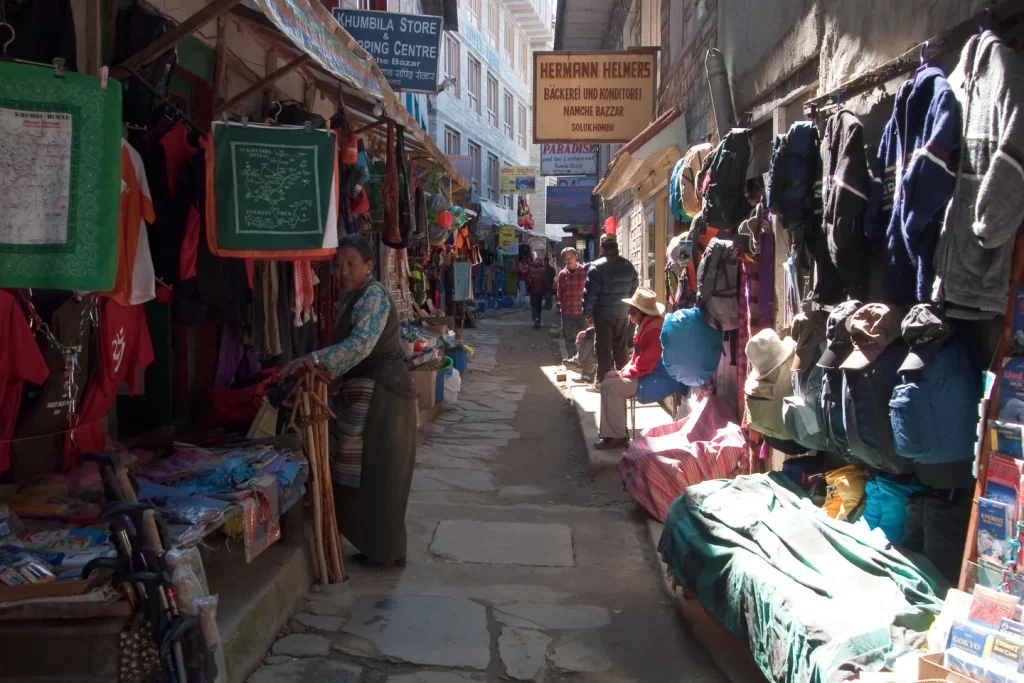
Namche Bazaar often appears in a journey description as the point before something else: a higher village, a valley or a base-camp route. It is worth reading the town on its own terms. Streets, shops, homes and the surrounding slopes form part of an inhabited landscape, rather than a waiting room for a mountain achievement.
Nepal Tourism Board describes Namche as a historic trading hub and a present-day center for visitors to the region. That combination helps explain why a practical shopfront and a wide mountain view can belong to the same place. Neither cancels out the other.
Begin at the scale of the street
Look at how a street works before deciding what to photograph. Entrances, steps, goods being moved and people going about their day tell you something about the town’s ordinary rhythm. Keep access clear and ask before making a close photograph of a person or their work.
A shop can be useful without becoming a scene staged for a visitor. If you need something, ask clearly about the item and its current price. If you are simply looking, be considerate of the people working there. A friendly conversation should follow the other person’s interest and time, rather than an expectation that everyone will tell a travel story.
Give names their proper meaning
Sherpa refers to a people and cultural identity, not a generic name for anyone carrying equipment or working on a trek. People in the region hold many roles and have individual names, histories and areas of knowledge. Use a person’s name or actual role when you know it, and avoid assigning an identity from clothing or appearance.
The town is also part of a much wider network of settlements. Khumjung and Khunde, for example, deserve attention as places rather than optional additions to a checklist. If they interest you, discuss the route and its suitability within your overall plan with a qualified local professional.
Use a viewpoint to understand the setting
A distant photograph can make the town’s levels easier to understand, but a viewpoint does not identify every mountain automatically. Ask which direction you are looking and use a reliable reference when naming peaks. The opening photograph on this website shows Namche facing the Kongde Ri group; it is not a photograph of the Everest summit.
Cloud and changing light may obscure part of the scene. That is part of the region as it exists, not a failed visit. A street, a wall or a quiet conversation can remain meaningful when the distant view is incomplete.
Useful questions for a town visit
- What is this place called, and how is the name pronounced locally?
- Is this entrance or courtyard open to visitors?
- May I photograph the person, work or interior in front of me?
- Which settlement or mountain is visible from this direction?
- How does this outing fit the wider route and conditions?
Keep the practical plan separate from the picture
Do not infer a suitable walking schedule, an overnight plan or current facilities from a photograph of a busy town. Those decisions depend on your circumstances and the conditions of the actual journey. A regional guide can help you ask better questions, but it cannot provide a personalized high-altitude plan.
Before choosing an activity, understand who is responsible for the arrangements and how changes will be handled. Keep current official visitor information and your provider’s written details available. Any health questions about high-altitude travel belong with a qualified healthcare professional.


Private Bhaktapur and Nagarkot Day Tour From Kathmandu
The day trip to Bhaktapur and Nagarkot from Kathmandu takes you to the ancient city of Bhaktapur and the most popula...

UNESCO Seven World Heritage Tour in Kathmandu
There are seven awe-inspiring UNESCO World Heritage Sites in the Kathmandu Valley. Dating back over 2000 years, the...

Kathmandu: Full Day Top 4 UNESCO Tour with Lunch - Private/Group
A Kathmandu sightseeing tour is a captivating journey through Nepal's rich cultural and spiritual heritage. Start yo...

ZipFlyer Nepal - The World's Steepest Zip-line
Welcome to the most stunning Zipline on the planet. Zipflyer Nepal is a 1.8km Zipline located in Pokhara Nepal with a 600m descent (making it the Worl...

Jungle Towernight Stay In Chitwan National Park ,nepal-2 Nights 3 Days Package
Dreamt about sleeping inside Jungle ? Here we make your dream come true . The jungle tower are wooden tower built in...

Knife (Khukuri) Making Workshop- Forge of the Gurkhas
The khukuri is the symbol of loyalty and Gurkha warrior, regarded as traditional to all hill tribes of Nepal,also a...

1 Hour Mount Everest flight from Kathmandu With Hotel Pick Up
Mount Everest commercial flight from Kathmandu is a popular touristic thing to do in Nepal. It is best for the peopl...
Continue with the Khumbu landscape guide or compare the questions to ask about overnight stays. The aim is a fuller understanding of the region, including the places between its famous viewpoints.
Background: Nepal Tourism Board on Namche Bazaar and UNESCO’s Sagarmatha National Park entry. Operational and health advice must be checked through appropriate current sources.

Landing Everest Base Camp Kalapathar by Helicopter with Breakfast
Helicopter tour to Everest base camp:- Landing at Mt. Everest base camp, Kalapather with the best view of Mt Everest & other Himalayas, It is a landin...

Kathmandu Sightseeing | UNESCO World Heritage sites Private/Group
Embark on a captivating journey through Kathmandu with our Private Kathmandu Sightseeing Tour. Led by our expert Eng...

Kathmandu: Full Day 7 UNESCO Tour with Lunch - Private/Group
The Seven World Heritage Day Tour of Kathmandu presents a distinctive convergence of history, culture, and spiritual...

Kathmandu Food and Drink Walking Tour
Namaste! Come hungry to explore Kathmandu's culinary wonders on an immersive walking tour led by a professional lice...